
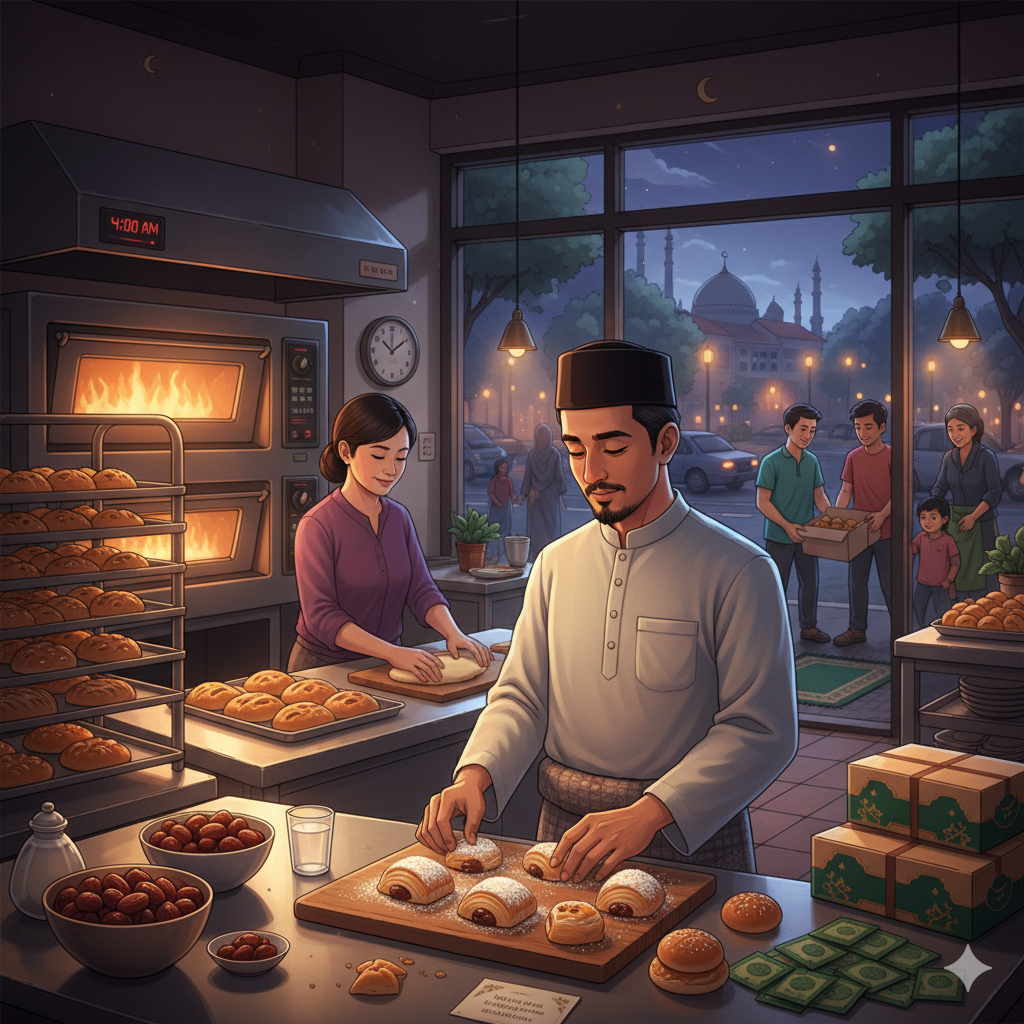
When the Bakery Transforms for the Holy Month
The first day of Ramadan arrived with a pre-dawn stillness that felt different from other mornings. Mei Lin woke at 4 AM to find Arif already dressed, moving quietly through their apartment. She’d been married to him for seven years, been through four Ramadans together, but this year felt different. This year, the bakery would fully participate.
“You’re fasting?” she whispered, not wanting to wake the neighbors.
Arif smiled, that gentle smile that had made her fall in love with him. “It’s my favorite month. Time to reset, reflect, reconnect.” He kissed her forehead. “Go back to sleep. I’ll handle the sahur prep at the bakery.”
But Mei Lin was already getting dressed. “We do this together.”
The streets of Petaling Jaya were surprisingly alive in the darkness. Cars headed to mosques for fajr prayer. Mamak stalls served their last meals before sunrise. Families gathered for sahur, the pre-dawn meal that would sustain them until sunset. The city had a different rhythm during Ramadan, a spiritual pulse that beat beneath the usual urban chaos.
At the bakery, Arif had already started preparing special Ramadan breads. The oven glowed warm in the darkness, and the scent of dates, cinnamon, and cardamom filled the air—different from their usual butter and vanilla, more complex, more intentional.
“During Ramadan, food has different meaning,” Arif explained as he shaped dough. “It’s not just about hunger. It’s about gratitude, discipline, community. The food we make now needs to honor that.”
Mei Lin watched him work, his movements almost meditative. She’d grown up celebrating Chinese festivals where food was abundance, celebration, joy. Ramadan was teaching her that food could also be restraint, anticipation, and spiritual practice.
The Challenge of Feeding the Fasting Community
By the time Ah Gong and the others arrived at their usual 7 AM, the bakery had transformed. Trays of kurma (date) pastries lined the cooling racks—flaky pastry wrapped around sweet date filling, dusted with powdered sugar. Fresh bread rolls perfect for sahur sat in baskets. A special roti john (Malaysian-style meat sandwich bread) was being prepared in bulk.
“Wah, so early already so productive!” Ah Gong exclaimed, eyeing the date pastries. “Can I try?”
“Of course,” Arif said. “In Islam, feeding others during Ramadan brings blessings. Doesn’t matter if they’re fasting or not.“
Priya arrived with news. “My apartment complex has many Muslim families. They asked if we can prepare iftar packages—the meal for breaking fast. Say they’re too tired after fasting to cook elaborate meals.”
“Iftar packages,” Mei Lin repeated, her business mind already calculating. “How many families?“
“At least twenty. Maybe more if word spreads.“
Zul burst through the door, unusually energetic for a teenager at 7 AM. “Boss! My ustaz said the surau needs bread for sahur. Can we donate? I can deliver before school!”
Arif’s face lit up. This was exactly what he’d hoped for—the bakery becoming part of the community’s Ramadan rhythm, not just a business but a service.
“We’ll prepare sahur packages for donation,” he decided. “And start taking orders for iftar.“
Mei Lin pulled out her notebook. Business was business, even during holy months. “We need a plan. Our regular orders don’t stop. We need to add Ramadan specials without burning out the team.“
“Especially since half the team will be fasting,” Priya pointed out. “You can’t expect Arif and Zul to work full days without food or water.“
That’s when the complexity hit them. During Ramadan, practicing Muslims fast from sunrise to sunset—no food, no water, no coffee. That meant Arif and Zul would be working in a bakery, surrounded by food they couldn’t eat, for 14-hour stretches.
“How do people do this?” Mei Lin asked, genuinely curious.
Arif smiled. “You’d be surprised what you can do when the intention is right. The first few days are hard. Then your body adjusts. Your mind clears. You start noticing things you miss when you’re constantly eating—like how much of our day revolves around food.”
“But working in a bakery while fasting?” Priya looked skeptical. “That’s like… extreme mode.“
“The Prophet, peace be upon him, worked while fasting,” Zul said with the confidence of teenage faith. “If he can fight battles while fasting, I can make bread.“
Ah Gong chuckled. “Young people, always so confident. Wait until day three when the headache comes.”
From Struggle to Spiritual Breakthrough
By day five, Ah Gong’s prediction came true.
Zul dragged himself into the bakery looking like he’d been hit by a truck. Dark circles under his eyes. Moving in slow motion. He’d clearly underestimated the challenge.
“Drink water,” Mei Lin said immediately.
“Cannot. Still fasting.” Zul slumped onto a stool. “Sahur at 5 AM feels so early. Then school all day. Then here. Then stay awake for evening prayers. Then finally eat. Then sleep so little because sahur is 5 AM again…“
Arif put a hand on his shoulder. “The first week is always hardest. Your body is detoxing. Fighting habits. Learning new discipline.”
“I don’t know if I can do this,” Zul admitted quietly. “Everyone at school making it look easy. But I’m dying.“
This moment of vulnerability from the usually confident teenager made everyone pause.
Arif sat down beside him. “You know what my teacher told me during my first Ramadan? He said, ‘Don’t fast with your stomach. Fast with your intention.’ You’re trying to be superhero—school, work, prayers, everything perfect. Maybe Ramadan is teaching you it’s okay to struggle. It’s okay to be weak. That’s when you learn to lean on Allah.”
“What if I fail?“
“Failing is breaking your fast without valid reason and not caring,” Arif said gently. “Struggling while trying your best? That’s actually the point. Allah doesn’t need our fasting. We need it. To remember we’re human, we’re limited, we need help.”
Mei Lin watched this exchange with growing understanding. Ramadan wasn’t about perfection. It was about the struggle itself being the lesson.
“Zul,” she said, “you don’t have to work full shifts this month. Come in after school for just a few hours. Focus on your studies and your ibadah—” she stumbled over the Arabic word for worship, “—your prayers. The bakery will survive.“
Tears welled in Zul’s eyes. That teenage pride warring with relief and gratitude. “Thank you, Kak Mei Lin.”
“And drink more water at sahur,” Ah Gong added practically. “Your headache is dehydration, not spiritual crisis.“
Everyone laughed, the tension breaking like dawn.
The iftar packages became unexpectedly popular.
Mei Lin had created simple but thoughtful combinations: fresh dates (essential for breaking fast), kurma pastries, savory roti john, a small container of sweet bubur kacang (mung bean porridge), and bottles of water. Everything packaged in eco-friendly boxes with a small card that read: “Berbuka dengan penuh kesyukuran” (Break your fast with gratitude).
Orders poured in. Not just from Priya’s apartment complex, but from offices, community centers, even a private hospital that wanted packages for Muslim staff working evening shifts.
“We’re making 200 iftar packages a day,” Mei Lin announced, equal parts thrilled and terrified. “At this rate, we’ll need to hire temporary help.“
That’s when the community stepped up in unexpected ways.
Pak Muthu, the Indian restaurant owner who’d let them use his ovens during Chinese New Year, appeared with his wife. “We’re Hindu, but in Malaysia, we help each other during holy times, no? My kitchen slow during Ramadan anyway. We help you prepare packages.”
The church volunteers who’d helped with CNY cookies called to offer afternoon shifts. “Our cooking ministry wants to serve the community. Tell us what to do.”
Even some of Priya’s aunties volunteered, curious about Ramadan practices and eager to help.
What emerged was beautiful: A multicultural assembly line in the bakery each afternoon. Chinese volunteers packing dates. Indian aunties carefully wrapping roti john. Church members portioning bubur kacang. Everyone working together to help Muslims break their fast.
“This is Malaysia,” Ah Gong said, surveying the scene with satisfaction. “Different religions, different foods, but same heart. We take care of each other.“
The real test came during the last ten days of Ramadan—the most sacred period.
Arif started staying at the mosque for i’tikaf, a spiritual retreat where he’d spend nights in prayer and reflection. He’d come to the bakery for just a few hours daily, moving through his work with a distracted, distant energy—physically present but spiritually elsewhere.
“Is he okay?” Priya whispered to Mei Lin. “He seems… different.“
“He’s searching for Lailatul Qadr,” Mei Lin explained, remembering Arif’s passionate explanation. “The Night of Power. One night during these last ten days when the Quran was first revealed. He believes one night of worship then is worth more than a thousand months.“
“So he’s not sleeping?“
“Very little. Praying, reading Quran, reflecting.” Mei Lin looked at her husband with a mixture of concern and awe. She’d never seen him so focused, so driven by something beyond the material world.
On the 27th night—the most likely night for Lailatul Qadr—Arif came to the bakery at 3 AM after prayers.
Mei Lin had stayed up, unable to sleep. She found him in the kitchen, not working, just sitting quietly, his hands cupped in prayer position.
“Did you find it?” she asked softly. “The special night?“
Arif opened his eyes, and Mei Lin saw something different there—a peace, a clarity, a kind of glowing exhaustion.
“I don’t know if it was tonight or another night,” he said honestly. “But I found something. This feeling of… surrender. Like I’ve been carrying so much—worry about the business, about money, about being good enough—and tonight I just… let it go. Put it in Allah’s hands. Felt lighter than I have in years.“
He looked at his wife, this Chinese woman who’d chosen to share his life, who respected his faith even though she didn’t share it, who’d woken at 3 AM just to be there for him.
“Thank you,” he said, “for making space for this. For understanding that some things matter more than productivity or profit.“
Mei Lin took his hand. “You’ve taught me that food can be more than taste. It can be intention, gratitude, discipline, love. That’s worth more than any profit.”
They sat together in the quiet bakery, the ovens cool for once, the pre-dawn stillness sacred even to those who didn’t share the faith.
The Eid Celebration That Brought Everyone Together
Eid morning arrived in an explosion of joy.
After 30 days of fasting, discipline, and spiritual focus, the Muslim community erupted in celebration. New clothes, special prayers, open houses, forgiveness exchanged, children receiving money in green packets.
Rasa Sayang Bakery had prepared special Eid cookies—almond crescents, cornflake cookies, pineapple tarts with a Middle Eastern twist (rose water in the filling). The display was festive: green and gold decorations, “Selamat Hari Raya” banners, platters of cookies for customers to sample.
But the real magic happened when Arif invited the whole team to his family’s open house.
Mei Lin, Priya, Zul, Ah Gong, Pak Muthu and his family, the church volunteers—everyone who’d helped during Ramadan. They gathered at Arif’s family home in Shah Alam, a traditional kampung-style house with a garden full of guests.
Arif’s mother, Mak Midah, a formidable woman in a stunning baju kurung, welcomed everyone with genuine warmth. “Come, come! Today is for celebrating and forgiveness. Everyone is family!”
The spread was incredible: rendang, lemang, ketupat, satay, kuah kacang, various kuih, and of course, cookies from the bakery. Guests ate, laughed, took photos, the atmosphere one of pure joy.
Ah Gong sat with Arif’s elderly father, Pak Long, both old men finding common ground despite language barriers—shared stories told through gestures, laughter, and the universal language of grandparent complaints about young people.
Priya learned to tie a headscarf from Arif’s younger sister, both women giggling as Priya’s first attempts slipped sideways. “It’s harder than it looks!” Priya exclaimed.
Zul, energized after finally eating normally again, ran around with Arif’s nephews, teaching them the TikTok dances he’d created during Ramadan.
Mei Lin found herself in the kitchen with Mak Midah, learning the secret to perfect rendang.
“You take care of my son,” Mak Midah said, not a question but a statement of fact.
“He takes care of me too,” Mei Lin replied.
The older woman nodded, satisfied. “Good marriage is like good rendang. Need patience, the right ingredients, and long, slow cooking. Cannot rush. Cannot force. Just… trust the process.”
Mei Lin realized they weren’t really talking about rendang anymore.
As the sun set on Eid day, the team gathered on the back porch, exhausted but content.
“So,” Priya started the now-familiar ritual, “what did we learn from Ramadan Rush?”
“That fasting while working in a bakery should be an Olympic sport,” Zul said immediately. “I deserve a medal.”
“That food means different things in different contexts,” Mei Lin offered. “During CNY, food is abundance. During Deepavali, food is light and celebration. During Ramadan, food is restraint and then gratitude. Same bakery, different meanings.”
“That community service is good business,” Priya added. “We made so many connections through the iftar packages. People remember who helped them during important times.”
Ah Gong spoke thoughtfully. “That religion is personal, but kindness is universal. We all different beliefs, different practices. But helping each other? That’s same everywhere. That’s what makes Malaysia work.”
Arif, who’d been quiet, finally spoke. “I learned that sharing my faith doesn’t mean converting anyone. It means living it honestly and letting others see. Mei Lin, Priya, Ah Gong—you all participated in Ramadan in your own ways. Not fasting, but supporting those who do. That’s its own kind of worship. The worship of community.”
A comfortable silence settled over them, the kind that comes from shared experience and mutual respect.
“You know,” Zul said suddenly, “my ustaz said Ramadan is training for the rest of the year. Like, if we can discipline ourselves for 30 days, we can do anything.”
“Good,” Mei Lin said with a grin, “because we have a big catering order next month. A corporate event for 500 people. We’ll need that Ramadan discipline.”
Everyone groaned, but it was the groan of a team that knew they’d face the challenge together.
[CLOSING SCENE]
Late that night, Mei Lin found Arif praying in their apartment. She waited until he finished, watching the way he bowed, prostrated, whispered prayers in Arabic she didn’t understand but could feel the sincerity of.
When he finished, she asked the question that had been on her mind all month.
“Do you ever wish I was Muslim? That I could fast with you, pray with you, truly share this part of your life?“
Arif considered carefully. “Sometimes. But then I think—you respect my faith enough to wake at 3 AM to sit with me. You work harder during Ramadan so I can focus on worship. You learn about my beliefs without me asking. That’s its own kind of sharing.” He took her hand. “Islam teaches that there’s no compulsion in religion. I chose you knowing you’re not Muslim. I choose you every day, exactly as you are.”
“And if our children—” Mei Lin started.
“Will learn both cultures, both traditions,” Arif said firmly. “Will learn that love means respecting differences, not erasing them. Just like our bakery.”
Mei Lin leaned against him, this man who’d taught her that faith could be gentle, that discipline could be freeing, that food could be sacred.
“Same time next Ramadan?” she asked.
“Insya’Allah,” he replied. “If God wills.”
And somehow, Mei Lin knew He would.
[POST-CREDIT SCENE – Two Weeks Later]
Inspector Wong appeared at the bakery, her timing impeccable as always.
“I heard about your Ramadan iftar packages,” she said without preamble. “Very impressive. Community service and business innovation.“
“Thank you, Inspector Wong,” Mei Lin said, wondering where this was going.
“My nephew is getting married. Buddhist ceremony, but many Muslim colleagues. Can you create something… appropriate? Halal cookies for Muslim guests, traditional Chinese for others, all prepared properly?“
Mei Lin smiled. After CNY chaos, Deepavali lessons, durian debates, and Ramadan rush, this felt almost easy.
“Of course. Respecting different needs is what we do.“
Inspector Wong almost smiled. Almost. “You know, when I first inspected this bakery, I thought you were crazy. Mixed-marriage owners, multiracial staff, trying to serve everyone. Thought it would fail within a year.”
She paused at the door. “I was wrong. You’re not trying to serve everyone. You’re trying to respect everyone. That’s different. That’s… rare.”
And then she was gone, leaving the team staring at each other in shock.
“Did Inspector Wong just give us a compliment?” Priya asked.
“I think she did,” Mei Lin said slowly.
“Quick, someone check outside. Is the moon turning blue?” Zul joked.
Ah Gong laughed that deep, satisfied laugh. “Even the hardest hearts soften eventually. Just takes patience, consistency, and good food.“
“Patience, sayang,” Arif quoted with a grin. “Good food takes time.”
“And good community takes even longer,” Mei Lin finished. “But we’re getting there. One festival, one cake, one crisis at a time.”
Outside, Petaling Jaya hummed with its beautiful, chaotic symphony—calls to prayer mixing with Chinese temple bells, Tamil music from a nearby shop, the smell of nasi lemak and roti canai and char kuey teow all competing in the humid air.
Malaysia. Impossible on paper. Beautiful in practice.
Just like Rasa Sayang Bakery.
Just like family.