
When Three Cultures Meet in Matrimony
The wedding invitation arrived in an ornate cream envelope, hand-delivered by a nervous-looking young woman in designer clothes. She introduced herself as Melissa Tan, personal assistant to the Wong-Kumar-Ibrahim family.
“The Wong-Kumar-Ibrahim family?” Mei Lin repeated, puzzled by the triple surname.
Melissa explained with practiced efficiency: “Miss Jasmine Wong is Chinese, her fiancé Raj Kumar is Indian, and they’re having a traditional Malay ceremony because they met at a Malay wedding and consider it their lucky culture.” She paused for breath. “They want a wedding cake that represents all three cultures. For their three-day celebration. They saw the TV documentary about your flood relief work and decided you’re the only bakery that truly understands Malaysian diversity.”
Arif raised his eyebrows. “Three-day wedding?”
“Day one is Chinese tea ceremony and banquet,” Melissa ticked off on her fingers. “Day two is Indian ceremony and reception. Day three is Malay bersanding and feast. Three hundred guests each day, though some overlap. They want a different cake for each day—but the cakes must somehow connect, tell a story, represent their journey together.”
Priya whistled low. “That’s not a wedding cake order. That’s a cultural diplomatic mission.”
“Precisely!” Melissa beamed. “Which is why they want Rasa Sayang Bakery. You’re famous now—the bakery that brings cultures together.”
Famous. The word sat uncomfortably. After the TV documentary aired, business had exploded. Food bloggers, tourists, media requests—the quiet neighborhood bakery had become a destination. They’d hired two additional staff just to keep up. Success should feel good, but lately, it felt overwhelming.
“When’s the wedding?” Mei Lin asked.
“Three weeks.“
Ah Gong choked on his kopi-o. “Three weeks? For three wedding cakes, each representing different culture, for three hundred people each day?”
Melissa nodded apologetically. “I know it’s tight. But they saw your documentary last week and became obsessed. They’re offering triple your usual rate. Plus full credit and promotion. This could really elevate your brand—”
“We’re not a brand,” Mei Lin interrupted sharply, surprising herself with her vehemence. “We’re a bakery.”
An awkward silence fell.
Melissa looked uncertain. “I’m sorry if I offended. But… will you consider it? The couple really loves what you stand for. They think if anyone can create cakes that honor all three cultures authentically while celebrating their union, it’s you.”
**Mei Lin looked at her team—**Arif, Priya, Ah Gong, Zul, and the two new hires, Sarah and Kumar. They all looked back, waiting for her decision.
This is what they’d built the bakery for, wasn’t it? To celebrate Malaysian diversity through food. To bring cultures together. But three weeks, three cakes, three hundred guests per day—it was insane.
“Can we meet the couple first?” Mei Lin asked. “Before we commit to anything, we need to understand what this wedding really means to them.”
Meeting the Happy Couple Reveals Complexity
Jasmine Wong and Raj Kumar arrived at the bakery the next day, and within five minutes, it was clear why they needed a three-day, three-culture wedding.
Jasmine’s mother—a elegant, formidable Chinese woman—had very specific ideas about proper Chinese wedding traditions. “The tea ceremony must be exactly right. The cake must have gold, must have double happiness symbol, must bring good fortune.“
Raj’s mother—a warm but equally firm Indian woman—had her own non-negotiable requirements. “Indian wedding cake must have traditional elements. Saffron, cardamom, rose water. Must be vegetarian—no eggs!“
And both mothers had agreed that since the couple met at their friend’s beautiful Malay wedding, they should honor Malay traditions too, which meant another full ceremony and another cake.
Jasmine and Raj sat between their mothers like prisoners, clearly in love but overwhelmed by the cultural expectations being heaped upon them.
“What do YOU want?” Priya asked them directly, cutting through the mothers’ planning.
The couple looked at each other, a whole conversation happening in that glance.
“We just want our wedding to be… us,” Jasmine said quietly. “We’re both Malaysian. We grew up eating each other’s food, celebrating each other’s festivals. Raj came to my Chinese New Year celebrations, I went to his Deepavali parties. We’re not trying to blend three separate cultures. We’re already blended. That’s just Malaysia.”
“But our families…” Raj gestured helplessly at their mothers, who were now debating whether gold or silver accents were more auspicious.
“Want traditional weddings that honor heritage,” Arif finished, understanding completely. He’d navigated similar waters with his own mixed marriage.
“So how do we make cakes that honor tradition but also honor truth?” Mei Lin asked. “Cakes that make the families happy but also represent who you actually are?”
That was the real challenge: Not just making three beautiful cakes, but **creating something that bridged the gap between what the families wanted and what the couple needed—**validation that their multicultural love story wasn’t a compromise between three separate identities, but a celebration of one beautifully blended Malaysian identity.
The Team Faces Their Own Growing Pains
That evening, after the consultation, tension cracked open in the bakery.
“We can’t do this,” Priya said flatly. “Three massive cakes in three weeks, each culturally perfect, plus all our regular orders? Plus the tourist crowds we can barely handle? We’re already working twelve-hour days!”
“We have to do this,” Zul argued. “This could be huge for us! Triple rate, massive promotion—”
“We’re not doing this for money or promotion!” Mei Lin snapped, her stress erupting. “We’re doing it because—because—”
She stopped, suddenly unsure why they were doing it.
Sarah, one of the new hires, spoke up tentatively. “I thought we were doing it to help the couple? They seemed really stressed.”
“Since when is it our job to fix other people’s family drama?” Priya shot back. “We make cakes. We don’t make miracles.”
“We kind of do, though,” Kumar, the other new hire, said quietly. “I mean, I took this job because of the documentary. Because this bakery seemed like it was about more than just baking. It was about… community, cultural respect, bringing people together.”
“That’s marketing talk,” Priya said bitterly. “The reality is we’re exhausted, overwhelmed, and being asked to do the impossible—again.”
Ah Gong, who’d been silent through the argument, finally spoke.
“Priya is right.“
Everyone turned to him in surprise.
“We are exhausted. We are overwhelmed. Since TV documentary, this bakery change. More customers, yes. More money, yes. But also… more stress. Less joy. Less family feeling.” His weathered face was sad. “We used to bake because we love it. Now we bake because people expect it. That is different.”
“So we should say no to the wedding?” Arif asked.
“I don’t know,” Ah Gong admitted. “But I know we cannot continue like this—always saying yes, always taking on more, always trying to be heroes. That is not sustainable. That is path to burnout and resentment.”
Mei Lin felt tears threatening. Everything Ah Gong said was true. Success had brought new problems. They’d gone from struggling neighborhood bakery to celebrated cultural institution, but somewhere in that transformation, they’d lost something essential.
“Maybe we need to remember why we started,” Arif said softly. “Mei Lin wanted to create a place where cultures came together through food. Where tradition met innovation. Where community mattered more than profit.”
“Have we lost that?” Mei Lin whispered.
“Not yet,” Ah Gong replied. “But we’re close. Very close.”
The Decision to Draw Boundaries
The next morning, Mei Lin called Melissa with their decision.
“We’ll do the wedding cakes. But on our terms.“
Melissa sounded relieved but cautious. “What terms?”
“First: we close the bakery to regular customers for those three weeks. We focus ONLY on this wedding. No tourists, no media, no regular orders except for our neighborhood regulars who’ve been with us since the beginning.“
“Second: we work reasonable hours. No overnight baking marathons. No pushing ourselves to exhaustion. Good work requires rested people.“
“Third: Jasmine and Raj must be involved in every design decision. These are THEIR wedding cakes, not their mothers’ cakes. If the mothers don’t like it, they can hire a different bakery.“
“Fourth: no cameras, no social media posts, no ‘behind-the-scenes content.’ This wedding is private, sacred. We’re not performing cultural diversity for an audience. We’re honoring a real couple’s real marriage.“
“And fifth:” Mei Lin took a deep breath, “if at any point this stops feeling right—if we’re compromising our values or our health—we reserve the right to step back and recommend another bakery. The couple’s happiness matters, but so does ours. We can’t pour from an empty cup.”
There was a long pause.
“I need to check with the family,” Melissa finally said.
Two hours later, she called back. “They agree to all terms. Jasmine actually cried with relief when she heard term three. Apparently, her mother has been bulldozing all her wedding decisions. This gives her permission to stand up for herself.”
“Then we have a deal,” Mei Lin said.
After hanging up, she looked at her team—tired but lighter, relieved that someone had finally said ‘enough.’
“We’re doing this,” she announced. “But we’re doing it our way. Slowly. Carefully. With boundaries. With rest. With joy instead of obligation.”
“How very un-Malaysian of us,” Zul joked. “Usually, we just work until we drop.”
“Maybe it’s time to change that,” Priya said thoughtfully. “Maybe sustainable cultural celebration means protecting the celebrators, not just the traditions.”
Creating With Intention, Not Just Ambition
The design process became unexpectedly therapeutic.
Instead of rushing to create three separate cakes, they took time to understand the story. Jasmine and Raj came to the bakery every few days, not as stressed customers but as collaborators and friends.
They shared their love story: Meeting at a mutual friend’s Malay wedding, bonding over their shared love of food from all cultures, navigating family expectations while staying true to themselves, learning that being Malaysian meant not having to choose between identities but celebrating them all simultaneously.
“We don’t want three separate cakes that happen to be at the same wedding,” Jasmine explained. “We want three cakes that are clearly part of the same story. Connected. A trilogy, not a random collection.”
That sparked Ah Gong’s creativity.
“What if,” he suggested, “each cake builds on the previous one? Day one cake introduces elements. Day two cake develops them. Day three cake completes the story?”
“Like a visual narrative,” Mei Lin breathed. “Each cake is beautiful alone, but together, they create something larger.”
The design came together organically over late-night tea sessions:
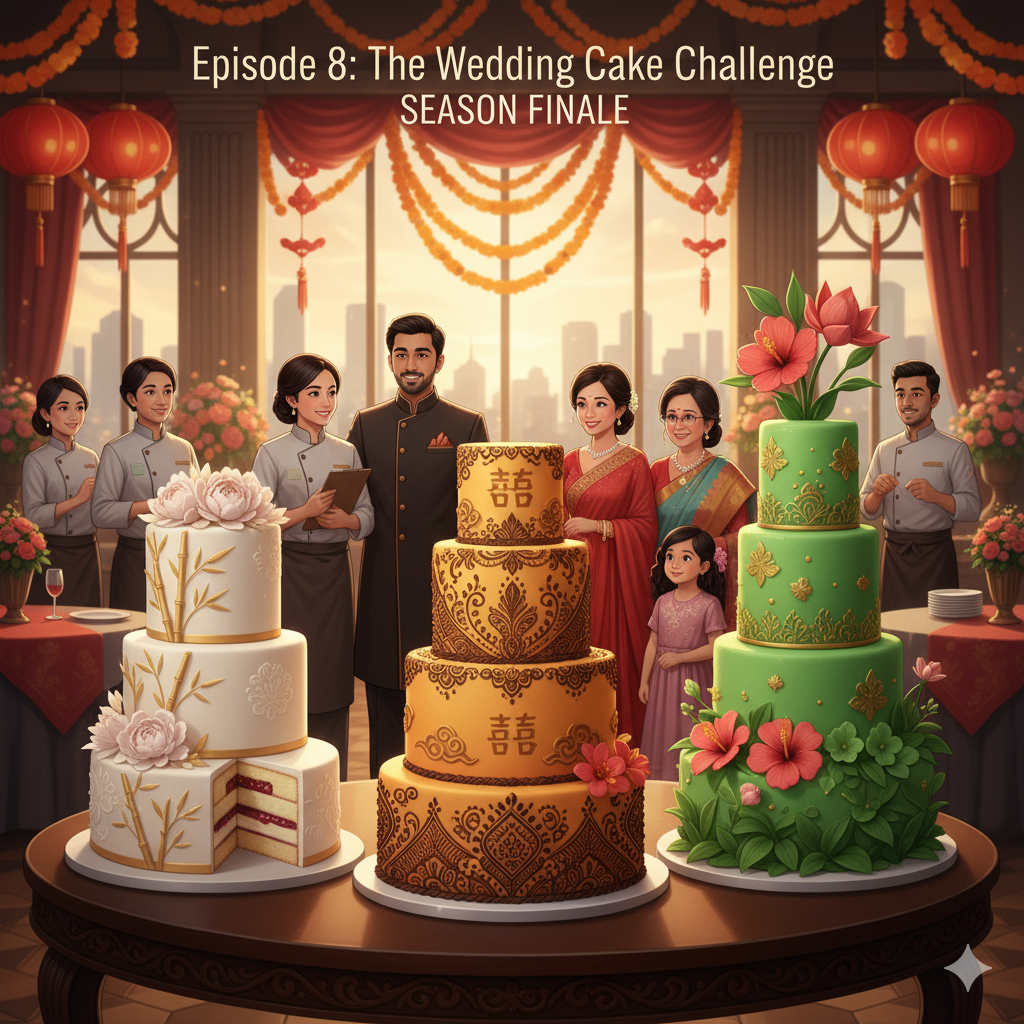
Day One – Chinese Tea Ceremony: A **traditional white wedding cake with subtle Chinese elements—**delicate gold accents in the pattern of bamboo (representing strength and flexibility), hidden red bean paste layers (honoring Chinese ingredients), topped with sugar-work peonies (prosperity and romance). The cake’s base would feature a small, barely visible Indian paisley pattern—a hint of what’s to come.
Day Two – Indian Ceremony: A saffron-and-cardamom flavored cake (egg-free to honor vegetarian requirements) with intricate henna-inspired piping. The design would incorporate Chinese cloud motifs merged with Indian paisley, showing the two cultures beginning to intertwine. Malay bunga raya (hibiscus) flowers in sugar work would appear subtly, foreshadowing day three.
Day Three – Malay Bersanding: The **most elaborate cake—**a tower of ondeh-ondeh-inspired layers (pandan cake with palm sugar filling) decorated with all three cultural elements fully integrated. Chinese gold leaf, Indian henna patterns, and Malay floral motifs would blend seamlessly into one cohesive design. The cake would be crowned with a sugar sculpture: three flowers—peony, lotus, and hibiscus—intertwined as one bloom.
“It’s perfect,” Jasmine whispered when they presented the designs. “It’s exactly us. Starting separate, coming together, becoming one while staying three.”
Her mother studied the designs critically. “The Chinese elements are quite subtle.”
“Because Chinese culture in Malaysia doesn’t exist in isolation,” Mei Lin said respectfully but firmly. “It exists alongside, intertwined with other cultures. That’s not dilution. That’s reality. That’s strength.”
To everyone’s surprise, Jasmine’s mother smiled—really smiled. “You sound like my own mother. She used to say, ‘In Malaysia, we don’t lose our culture, we share it.’ I’d forgotten that.”
Raj’s mother nodded slowly. “My son is not less Indian because he loves Malay food and has Chinese friends. He’s more Malaysian. Maybe that’s better than any single culture alone.”
Watching the mothers begin to understand, Mei Lin felt something shift. This wasn’t just about cakes anymore. It was about helping families see that cultural preservation and cultural integration aren’t opposites—they’re partners.
The Three-Day Marathon Tests Everything
Week one of creation was methodical and mindful.
They closed to tourists as promised, which meant disappointing dozens of people but also meant the bakery felt like home again. Just the team, working at a sustainable pace, rediscovering the joy of baking.
Ah Gong taught Sarah and Kumar the traditional techniques, passing down knowledge with the patience they hadn’t been able to afford during the tourist rush. “Slowly, slowly. Good sugar work cannot be rushed. Must let it cool at its own pace, must handle with gentle confidence.”
Priya perfected the saffron-cardamom cake, working through multiple recipes until the flavor was perfect—Indian spices present but not overwhelming, complementing rather than dominating. The egg-free requirement pushed her to master new techniques, and she emerged more skilled than before.
Arif focused on the Malay elements, working with his mother again (Mak Midah had become an unofficial bakery consultant). The ondeh-ondeh-inspired cake required precise engineering—how to create the signature “burst” of palm sugar without actual liquid centers that would compromise structural integrity?
Mei Lin orchestrated everything, but differently than before. Instead of controlling every detail, she trusted her team. Instead of working twelve-hour days, she enforced an eight-hour limit. Instead of seeking perfection, she aimed for excellence with sustainability.
Week two brought challenges.
The Chinese peony sugar work kept cracking—too humid, too delicate. After the fifth failure, Ah Gong sat Zul down for a teaching moment.
“Why you think it keep cracking?“
“Because I’m doing it wrong?” Zul guessed.
“No. Because you rushing. You thinking about end result instead of present moment. Sugar work is meditation—must be here, now, fully present. When your mind is on what comes next, your hands forget what they doing.“
Zul tried again, this time slowly, breathing deeply, focusing only on the current petal. The peony emerged perfect—delicate, lifelike, strong.
“See?” Ah Gong smiled. “Patience. Presence. That is secret to all good cooking.”
**Week three was assembly—**the most stressful part.
Day One Cake went together smoothly, the white tiers stacking perfectly, the gold bamboo patterns catching light beautifully, the hidden red bean layers a delicious surprise. Jasmine’s mother cried when she saw it. “It honors tradition while being completely modern. It’s perfect.”
Day Two Cake challenged them with the egg-free structure—would it hold? But Priya’s engineering proved sound. The saffron-cardamom layers were stable, moist, flavorful. The henna piping took eight hours of steady hand work, but when finished, it looked like edible art. Raj’s mother brought all her sisters to see it. They took photos from every angle, marveling at how the Indian and Chinese elements danced together.
**Day Three Cake was the monster—**tallest, most complex, most technically demanding. Four tiers of pandan cake with palm sugar filling, each layer requiring precise timing so the filling would create that signature ondeh-ondeh experience. The decorative integration of all three cultural elements required the entire team working in coordinated precision.
At 2 AM the night before day three, with the final cake 75% complete, Arif’s hands started shaking from fatigue.
“Stop,” Mei Lin said firmly. “We rest.”
“But the cake—”
“Will still be here in the morning. We will not be if we don’t rest.” She looked at the team—everyone exhausted but pushing through. “Everyone go home. Sleep. Real sleep. We finish tomorrow with fresh eyes and steady hands.”
“But what if we don’t finish in time?” Sarah worried.
“Then we don’t finish in time,” Mei Lin said calmly. “The couple will have two beautiful cakes and our honest best effort. That’s more important than a perfect third cake made by people who destroyed themselves to create it.”
They slept.
And in the morning, refreshed and clear-headed, they completed the final cake in three hours. The work that had seemed impossible at 2 AM flowed easily at 8 AM with rested minds and steady hands.
**The three-flower crown—peony, lotus, hibiscus intertwined—**was the last element. Ah Gong and Zul created it together, teacher and student, old hands and young hands, Chinese Malaysian and Malay Malaysian, creating something that represented all of Malaysia.
When they placed it on top, everyone stepped back in awe.
Three cakes. Three days. Three cultures. One story.
The Wedding Reveals What Really Matters
The three-day wedding was magnificent.
Day One: The Chinese tea ceremony was intimate and moving. The cake cutting revealed the hidden red bean layers, and elderly Chinese relatives exclaimed with delight at the traditional flavor honored in modern form. Jasmine served tea to her elders with the cake on display behind her, the gold bamboo catching candlelight, tradition and innovation coexisting beautifully.
Day Two: The Indian ceremony exploded with color and joy. The saffron-cardamom cake was a hit with vegetarian guests and curious omnivores alike. The henna-inspired piping photographed beautifully against the bright silks and marigolds. Raj’s grandmother, a formidable woman who rarely smiled, took Priya’s hands and blessed her: “You honored our tradition while making something new. That is the highest compliment.”
Day Three: The Malay bersanding was the emotional climax. Jasmine and Raj sat on the pelamin (wedding dais) in traditional Malay attire, looking like royalty. When they cut the ondeh-ondeh-inspired cake, guests gasped at the burst of palm sugar filling—a perfect culinary surprise that delighted everyone.
But the moment that mattered most came later.
As the three cakes sat side by side during the final reception (the couple had requested all three be displayed together for one hour), a little girl—mixed Chinese-Indian, about six years old—approached Mei Lin.
“Miss, are you the baker?”
“Yes, sayang. I’m one of them.”
The girl pointed at the cakes. “My mummy is Chinese and my daddy is Indian. Kids at school ask me which one I am. I never know what to say.”
Mei Lin knelt down to the child’s eye level. “What do you think when you look at these cakes?”
The girl studied them carefully. “They’re all different. But they’re all beautiful. And they all go together.”
“Exactly. You’re like these cakes—Chinese and Indian, but also completely yourself. You don’t have to choose. You’re already whole, already perfect, already all of it at once.”
The girl smiled, understanding in a way that only children can. “Like Malaysia!”
“Just like Malaysia,” Mei Lin confirmed, tears in her eyes.
That night, after the wedding, the exhausted team sat in the bakery, their workspace a disaster of sugar flowers and piping bags and pans.
“We did it,” Zul said in disbelief. “We actually did it.”
“Not just did it,” Priya corrected. “We did it well. We did it sustainably. We did it without destroying ourselves. That’s the real achievement.”
“Also,” Kumar added, “we created something that made a little girl understand her identity better. That’s… that’s more than baking.”
Ah Gong smiled with deep satisfaction. “Now you all understand. This is why we bake. Not for money. Not for fame. Not even for beauty, though beauty is good. We bake to help people understand themselves, their culture, their place in this beautiful, messy, complicated Malaysia.”
“That is the real recipe.”
The Resolution: Redefining Success
One week after the wedding, the team held a meeting.
“We need to talk about the bakery’s future,” Mei Lin started.
After the wedding success and continued media attention, they had offers: Franchise opportunities. Cookbook deals. Television shows. A Malaysian tourism board partnership. All the trappings of success.
“These are good opportunities,” Arif said carefully. “But are they OUR opportunities? Do they align with why we started this bakery?”
Priya spoke up. “I’ve been thinking about what Ah Gong said—about baking to help people understand themselves. Franchising doesn’t do that. Franchising is about profit and expansion.”
“The cookbook might,” Sarah suggested. “Sharing recipes, sharing the philosophy behind them—that could help people.”
“If we write it ourselves, with our own voices, our own stories,” Mei Lin agreed. “Not as a marketed product but as a genuine sharing of what we’ve learned.”
Zul, now seventeen and much wiser than the boy who’d started a year ago, raised his hand. “What if we stayed small? What if success doesn’t mean bigger, but means better? More intentional. More impactful per person instead of reaching more people with less impact?”
Ah Gong beamed at him. “Now you’re thinking like true chef. Quality over quantity. Depth over breadth.”
The decision emerged organically:
They would stay one location. No franchise, no expansion. Rasa Sayang Bakery would remain a neighborhood bakery that occasionally took on special projects like the wedding.
They would limit tourist traffic—certain hours reserved for tourists, certain hours reserved for neighborhood regulars. The locals who’d supported them from the beginning deserved protected space.
They would write a cookbook—but on their terms, in their voice, when they had time to do it properly.
**They would accept media attention selectively—**only projects that genuinely aligned with their values, never for mere publicity.
They would prioritize team wellbeing—reasonable hours, fair pay, mental health support, sustainable practices. “Can’t serve community if we destroy ourselves serving community,” as Priya put it.
**And they would remember, always, that they were a bakery—**but also a family, a community center, a cultural bridge, a small but significant force for understanding in a diverse nation that didn’t always understand itself.
“So we’re choosing to stay small?” Melissa asked when Mei Lin called to decline most of the opportunities.
“We’re choosing to stay true,” Mei Lin corrected. “There’s a difference.”
The Final Scene: Full Circle
Six months later, Inspector Wong visited the bakery.
She’d become almost a regular, stopping by every few weeks, always official, always stern, but always finding reasons to compliment them indirectly.
This time, she had news.
“The ministry is creating a cultural heritage award. For businesses that preserve and celebrate Malaysian multiculturalism authentically.” She paused, almost smiling. “You’re the inaugural recipient.”
“We are?” Mei Lin was shocked.
“Apparently, a little girl wrote a letter. Mixed Chinese-Indian, about six years old. She wrote about attending a wedding where the cakes taught her it’s okay to be all of her cultures at once. Her letter went viral. The couple whose wedding it was shared your bakery’s name. Things… escalated.”
Inspector Wong placed an official-looking envelope on the counter. “The award ceremony is next month. You don’t have to attend if you don’t want the publicity. But I thought you should know—what you do here matters. You’re changing how people think about identity, culture, belonging. That’s bigger than any business success.”
After she left, the team gathered around the envelope.
“Should we accept?” Arif asked.
“Will it change us?” Priya worried.
Ah Gong chuckled. “We already change so much this year. Start as struggling bakery. Become shelter in flood. Become cultural heroes. Become wedding miracle workers. Now become award winners. But through all changes, we stay same in one way—we care about people more than profit. We care about truth more than image.”
“As long as we keep that,” he continued, “awards cannot spoil us. Fame cannot corrupt us. Success cannot ruin us. Because we know our real measure—not how many customers we serve, but how many hearts we touch.”
**Mei Lin looked around at her team—**Arif, her partner in life and business. Priya, who’d grown from anxious assistant to confident baker. Zul, transformed from eager teenager to thoughtful young chef. Ah Gong, the steady heart of everything they did. Sarah and Kumar, the new generation learning the values. **And outside the window, the neighborhood they served—**the real judges of their success.
“We’ll accept the award,” she decided. “Not because we’re proud—though we are. But because that little girl’s letter proves we’re doing what we set out to do. And if the award helps even one more person understand that being Malaysian means being many things at once, then it’s worth it.”
“Plus,” Zul added with his irrepressible grin, “free publicity!”
Everyone laughed, the sound filling the bakery the way it had from the beginning—genuine, joyful, unforced.
That evening, after closing, Mei Lin walked through the bakery alone, touching the counters where so much had happened: CNY chaos, Deepavali disasters, durian debates, Ramadan rushes, competition lessons, flood sheltering, wedding miracles.
One year. Eight major crises. Countless small moments.
They’d started wanting to build a successful business. Instead, they’d built something rarer: a genuine multicultural community where being different wasn’t just tolerated but celebrated. Where tradition and innovation danced together. Where helping others became the business model.
Her phone buzzed. A message from Jasmine and Raj:
“Just found out we’re pregnant! Baby due in six months. When the time comes, can Rasa Sayang Bakery make the full moon cake? Baby is going to be Chinese-Indian-Malay (by adoption of culture). We can’t imagine anyone else creating something that honors all three. ❤️”
Mei Lin smiled through tears.
The cycle continues. **New generations, new celebrations, new opportunities to show that Malaysian identity isn’t about choosing one culture—**it’s about embracing them all, letting them flavor each other like ingredients in a perfect recipe, creating something uniquely Malaysian, uniquely beautiful, uniquely whole.
She typed back:
“We would be honored. And congratulations! Malaysia needs more babies who grow up knowing they’re allowed to be everything at once. 💚💛❤️”
Outside, Petaling Jaya hummed its familiar symphony—calls to prayer, temple bells, church hymns, mamak stall conversations, a hundred languages and cultures mixing into one beautiful, chaotic, imperfect, perfect whole.
And in a small bakery on a slightly elevated street, the lights stayed on a little longer, the ovens cooling slowly, the smell of a hundred different bakes mixing into one signature scent that could only be described as:
Rasa Sayang.
The feeling of love.
Malaysian love. Complicated, multicultural, messy, beautiful, and absolutely worth celebrating.
One cake at a time.