
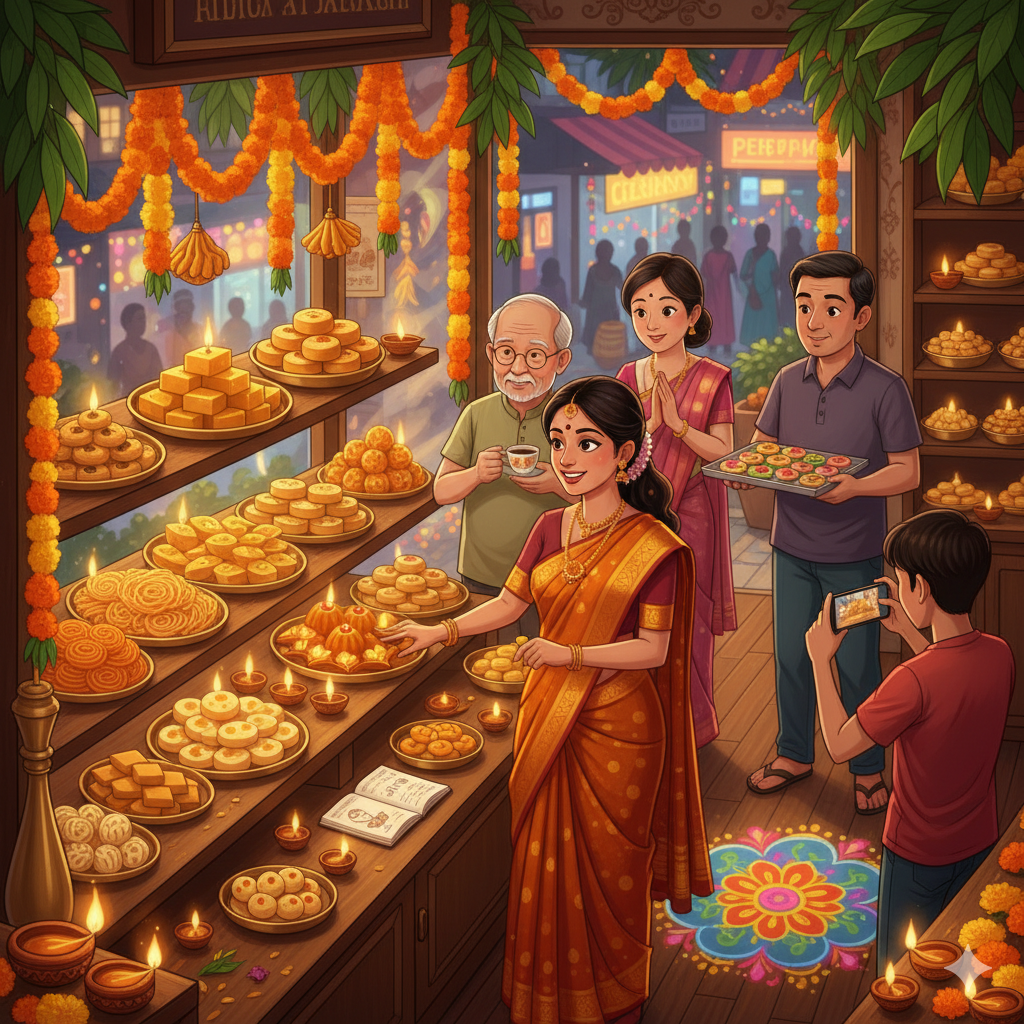
The October morning arrived with Priya practically vibrating with excitement as she unlocked the bakery doors. This was her moment. For the first time since joining Rasa Sayang Bakery, she would lead the creation of the Deepavali display—a showcase of South Indian sweets and savories that would sit proudly in the front window for all of Petaling Jaya to see.
“Cannot sleep last night,” she confessed to Mei Lin, who arrived to find Priya already measuring out ghee, jaggery, and rice flour. “Keep thinking about my paati’s halwa recipe. Must be perfect.”
Mei Lin smiled, remembering her own nervous energy before the pandan chiffon challenge. “Take your time. The best creations come from the heart, not the clock.“
But Priya had plans—big plans. Her notebook lay open on the counter, filled with sketches and recipes: traditional Mysore pak, cashew burfi, ribbon pakoda, murukku, and the centerpiece—a elaborate kesari halwa molded into the shape of a diya lamp. She’d been dreaming of this for months.
Ah Gong shuffled in with his morning kopi-o, took one look at Priya’s ambitious spread of ingredients, and chuckled. “Wah, young people always think big. Good, good. But remember—”
“I know, I know,” Priya interrupted affectionately. “Patience. Good food takes time.“
“Actually, I was going to say—make sure got enough cardamom. Indian sweets without cardamom like char siu without honey.” He winked.
That’s when Priya’s eyes lit up dangerously. “Cardamom! Ah Gong, you’re brilliant! What if we infuse cardamom into EVERYTHING? Cardamom pineapple tarts, cardamom almond cookies, cardamom kaya toast—”
Mei Lin’s smile froze. “Priya, sayang, that’s… very creative, but—”
“Fusion, right? That’s what we do here! Mix the cultures!” Priya was already grinding cardamom pods, the intense, almost medicinal aroma filling the kitchen. “For Deepavali week, we make everything celebration!“
Arif entered mid-conversation, immediately wrinkling his nose at the overpowering cardamom scent. “Wah, somebody spill perfume or what?”
By mid-morning, the bakery had transformed into what Zul later described as “a cardamom bomb exploded.” Every surface held some experiment in cardamom fusion. Priya worked with the focused intensity of an artist possessed, her hands moving between traditional Indian sweet-making and adapting Malaysian favorites.
The first casualty was the pineapple tarts.
Mrs. Chen, a regular customer for twenty years, bit into her usual order and immediately made a face like she’d tasted medicine. “Mei Lin ah, your pineapple tart… something wrong or not? Got funny taste.”
Mei Lin tasted one and suppressed a wince. The cardamom, fragrant and lovely in Indian sweets, clashed horribly with the sweet-tart pineapple filling. It was like watching two beautiful songs played simultaneously in different keys.
“I’ll make you a fresh batch,” Mei Lin promised, then gently approached Priya. “Maybe we should keep the cardamom just for the Indian sweets?”
But Priya was too deep in her vision to hear. “No, no, people need to expand their taste! This is fusion!” She was now adding cardamom to the kaya, creating a green-brown mixture that looked as confused as it tasted.
Zul whispered to Arif, “Boss, the whole bakery smells like my grandmother’s medicine cabinet.”
The problem intensified when the lunch crowd arrived. Uncle Kumar, excited for Deepavali treats, brought his Chinese and Malay colleagues to try “authentic Indian sweets.” What they got instead was Priya’s cardamom-everything approach.
The traditional Mysore pak was perfect—golden, crumbly, sweet with just the right hint of ghee and cardamom. Uncle Kumar closed his eyes in bliss. “Just like my mother used to make.“
But then his colleague tried the cardamom char siu bao.
The silence was deafening.
“It’s… interesting,” the colleague managed, his face a mask of politeness.
Priya’s confidence finally cracked. She looked around at the half-eaten fusion experiments, the wrinkled noses, the overpowering smell that had customers walking in and immediately walking out. Her dream showcase was becoming a disaster.
Ah Gong found her sitting in the back alley, her head in her hands, tears threatening. The proud, ambitious Priya had crumbled.
“I ruined everything,” she whispered. “Wanted to make Deepavali special, to show everyone how beautiful Indian sweets are. Instead, I made… medicine bao.”
The old man sat beside her on an overturned crate, his movements careful. “You know what your mistake was?”
“Too much cardamom?” Priya said bitterly.
“No. Too much trying to prove something.” Ah Gong’s voice was gentle. “You are already good enough, Priya. Your traditional sweets—that Mysore pak? Uncle Kumar cried. Real tears of memory. You don’t need to change everything to make people see how special your culture is.”
“But this bakery is about fusion—”
“Fusion is not about forcing things together,” Ah Gong interrupted. “Is about respecting each ingredient, each tradition. Then, only then, you see where they naturally meet.” He patted her hand. “Your paati’s recipes are already perfect. Honor them first. Fusion can come later, gently, like friends getting to know each other. Not like… how you say… shotgun wedding.“
Despite herself, Priya laughed through her tears.
The transformation began that afternoon. Priya cleared away all the fusion experiments and returned to her roots. She made ribbon pakoda the way her paati taught her—patient, careful layers of gram flour dough, each ribbon perfectly crimped. She crafted murukku in traditional spiral patterns, the rice flour mixture pressed through the ancient wooden mold her aunt had lent her.
The kesari halwa became her meditation. Slow-roasted semolina, ghee glistening, saffron threads releasing their gold into the mixture, and yes, cardamom—but in its rightful place, balanced and beautiful. She molded it into diya shapes, each one a small lamp of sweetness.
Mei Lin watched, learning. “Can you teach me? The proper way?”
“Would you teach me your pandan chiffon secrets?” Priya asked back.
“Of course. We learn from each other. That’s the real fusion.“
They worked side by side, Priya explaining why the ghee temperature mattered for Mysore pak, Mei Lin sharing how to judge pandan extract intensity by color and smell. Arif joined in, curious about adapting the murukku press technique. Even Zul took notes, his ambition to be a famous chef absorbing every lesson.
Ah Gong made his own contribution—he taught Priya the Chinese art of sugar work, showing her how to create delicate spun sugar to garnish her halwa diyas. “Different technique, same principle. Heat, patience, timing. All cooking is family.“
The Deepavali display that finally graced the bakery window was breathtaking. Traditional Indian sweets sat in pride of place—perfect gold Mysore pak, creamy cashew burfi, crispy ribbon pakoda forming decorative fans, murukku arranged like flowers, and the centerpiece kesari halwa diyas that seemed to glow even without flame.
But there was fusion too, gentle and thoughtful—Mei Lin had created a pandan-coconut burfi, inspired by Priya’s technique but honoring both flavors equally. Arif contributed kuih seri muka topped with a hint of saffron, a conversation between Malay and Indian traditions. These sat to the side, clearly marked as “Special Fusion Experiments”—not trying to replace tradition, but celebrating what happens when cultures truly listen to each other.
The morning of Deepavali, the bakery glowed. Strings of marigold flowers (courtesy of Priya’s aunt) draped the doorway. Small oil lamps flickered safely in the window. The scent was no longer overwhelming cardamom, but a harmonious blend—ghee, saffron, rose water, with undertones of pandan and coconut.
Uncle Kumar returned with his entire extended family. His mother, a tiny woman in a magnificent silk sari, tried the Mysore pak and burst into tears. “Just like home,” she said in Tamil, clutching Priya’s hands. “You remembered. You honored it.“
That was the moment Priya truly understood. Not the fusion experiments, not the cardamom chaos, but this—seeing an elderly woman taste memory, taste love, taste home in a simple sweet made with respect and care.
Inspector Wong appeared again (she seemed to have a sixth sense for bakery drama), this time with her teenage daughter. “My girl wants to learn about different cultures,” she explained, softer than her usual official tone. “I told her—best way is through food made with respect.”
Priya served them both, explaining each sweet, its significance, why Deepavali meant “festival of lights” and how each diya represented the victory of light over darkness, knowledge over ignorance. The teenager listened, fascinated, tasting not just sweets but stories.
That evening, after the rush had ended and the display had sold out (they’d had to make three emergency batches of Mysore pak), the team gathered for their own small Deepavali celebration.
Priya had made a special batch just for them—traditional sweets exactly as her paati made them, no experiments, no fusion, just pure tradition. She also brought out a small clay diya and lit it carefully.
“In my culture, we light lamps to invite Lakshmi, goddess of prosperity and light,” she explained. “But also to remember—darkness is not our enemy. Darkness makes us appreciate the light. My disaster with cardamom? That was my darkness.” She smiled. “Taught me to appreciate the light of tradition before trying to create new light.“
Mei Lin added her own diya. “And sometimes we need darkness to see where different lights can shine together.“
Ah Gong, surprising everyone, produced a Chinese lantern. “Different cultures, different lights. But all trying to chase away darkness, bring warmth, bring people together.” He hung it next to the diyas. “See? Not fusion. Just… friendship.“
Arif placed a small pelita, a Malay oil lamp, completing the circle. “Rasa Sayang,” he said simply.
Zul, ever the teenager, took a photo of the three lights together. “This is going to get so many likes,” he declared, then caught himself. “But also, it’s actually really beautiful. Like, meaningful beautiful.“
They sat in the warm glow of three different traditions lighting the same space, eating sweets that tasted of history, love, and hard-won wisdom. Outside, Petaling Jaya continued its beautiful chaos—different peoples, different faiths, different foods, all somehow making it work in the Malaysian way.
“So what did we learn?” Priya asked, echoing what had become their post-crisis tradition.
“That cardamom in pineapple tarts is a crime against humanity?” Zul offered.
“That traditional doesn’t mean boring,” Mei Lin said. “It means trusted. Tested. True.“
“That respecting where we come from makes us better at going somewhere new,” Arif added.
Ah Gong smiled into his tea. “That this girl makes very good Mysore pak. Uncle Kumar’s mother cried. In my forty years making food, I learn—you make someone cry happy tears with your cooking? That is real success.“
Priya felt warmth spreading through her chest, the kind that had nothing to do with cardamom or spices and everything to do with belonging. “Thank you. For letting me make mistakes. For teaching me it’s okay to honor tradition before breaking rules.“
“Rules are meant to be broken,” Mei Lin said with a grin. “But first, you must know why the rules exist.“
As they cleaned up, Priya noticed the empty fusion experiment tray. One piece remained—the pandan-coconut burfi that Mei Lin had made using Priya’s technique. Priya tried it.
It was delicious. Not trying to be Indian or Malaysian, just… honestly itself, born from two traditions meeting with mutual respect.
“Okay,” Priya admitted. “Maybe fusion can work. When done right.“
“Next time,” Mei Lin suggested, “we collaborate from the start. Plan together. Respect each tradition equally.“
“And maybe use less cardamom,” Zul muttered.
They all laughed, the sound carrying out into the Deepavali night, mixing with the sounds of firecrackers, prayers, and celebration happening all across the neighborhood.
In the window, the last kesari halwa diya caught the streetlight, seeming to glow with its own internal warmth—a small lamp of sweetness in a world that needed all the light it could get.
[LATE NIGHT SCENE]
Priya was locking up when a young Indian girl, maybe seven years old, pressed her face against the window, her mother pulling her along.
“Amma, look! Diyas made of sweet!” the child exclaimed in Tamil.
The mother smiled apologetically at Priya. “Sorry, we’re too late, shop is closed—“
Priya held up one finger, ducked inside, and returned with the last diya-shaped halwa, wrapped in gold paper. She pressed it into the child’s hands.
“Happy Deepavali, little one. May your light never go out.“
The child’s face lit up brighter than any lamp, and in that moment, Priya understood what Ah Gong meant. This wasn’t about proving anything. It was about sharing light.
The mother’s eyes glistened with tears. “Thank you. You’ve made her Deepavali magical.“
As they walked away, the child carefully cradling her halwa diya like treasure, Priya felt something settle in her heart—a sense of purpose that had nothing to do with ambition and everything to do with connection.
She turned off the bakery lights one by one, leaving only the small diyas burning in the window—lights for anyone who needed to remember that darkness is temporary, community is forever, and sometimes the sweetest victories taste like traditional Mysore pak made exactly the way your paati taught you.
Festival of Lights, indeed.